
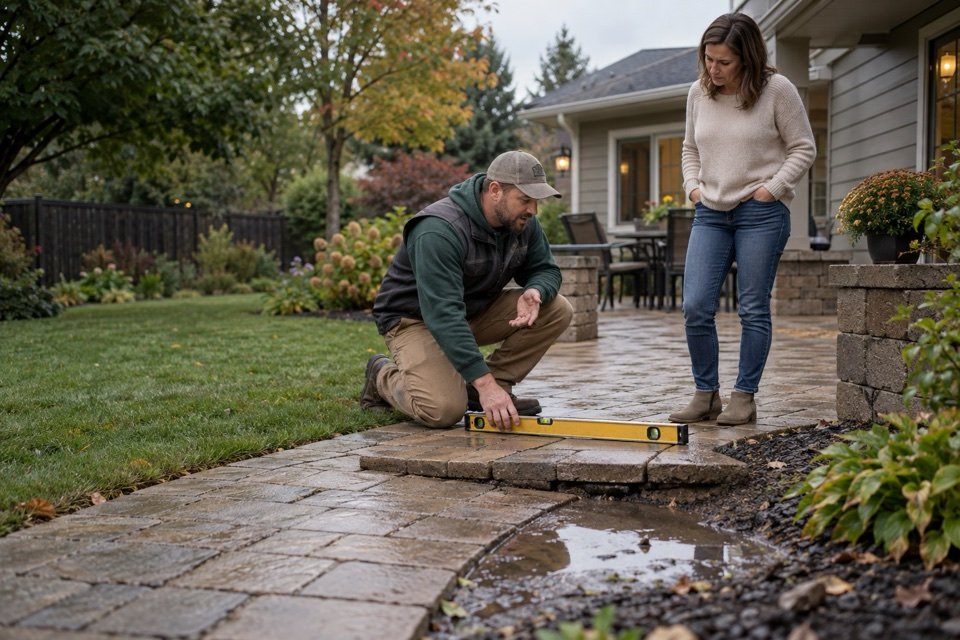
A paver patio can look solid for years and then develop a low corner, spreading joint or raised edge. A walkway may begin holding water in one spot or create a toe-catching transition where it meets a step. These changes are easy to label as “a few loose pavers,” but the visible surface rarely explains the complete problem.
Interlocking pavers work as a layered system. The native soil supports the compacted base. The base carries and distributes the load. A thin, consistent bedding layer helps seat the units. Edge restraint contains the field, and filled joints help the individual pavers behave together. Grade and drainage protect every layer. When one part loses support, the surface records the failure.
This guide helps Central Kansas property owners read those signs, understand why a cosmetic reset may not last, and know what a durable repair or replacement scope should address.
Start by mapping the pattern
Before lifting anything, look at the entire surface and the surrounding property. The shape of the movement often points toward the source.
- One small depression: may indicate a local soft spot, poorly compacted fill, loss of bedding material, animal activity or a previous trench.
- A low band along the house: may relate to disturbed backfill, roof runoff, a leaking downspout connection or unsuitable final grade.
- Edges spreading outward: often calls attention to missing, loose or undermined edge restraint.
- Waves across a large area: can indicate inconsistent excavation, base thickness, compaction or subgrade strength.
- One raised winter area: may involve moisture and freeze-thaw movement, tree roots or a localized subsurface condition.
- Settlement over a straight line: can follow a utility or drainage trench that was not rebuilt and compacted to match surrounding ground.
Take photos after rain and again when the area is dry. Mark where puddles form, which joints are widening and whether the problem changes seasonally. Check nearby downspouts, irrigation heads, planting beds and roof edges. A short record is more useful than trying to remember whether the low area grew gradually.
Cause 1: the soil below the project was not stable
Every patio begins with subgrade—the existing or prepared soil below the aggregate base. Organic topsoil, roots and construction debris do not provide uniform structural support. Recently placed fill can continue settling when it was not installed and compacted appropriately. Clay-rich or moisture-sensitive soil may change strength as water conditions change.
This is why removing only the pavers may not reveal enough. If the base is thin over a soft pocket, adding more bedding sand at the surface leaves the weak layer in place. The repair may look level until traffic, rain and seasonal movement compress it again.
A contractor should evaluate whether the failed area is isolated or part of a broader subgrade problem. The intended load matters too: a quiet backyard patio, a delivery route and a surface that occasionally receives a vehicle do not require identical support.
Cause 2: the aggregate base was too thin, uneven or poorly compacted
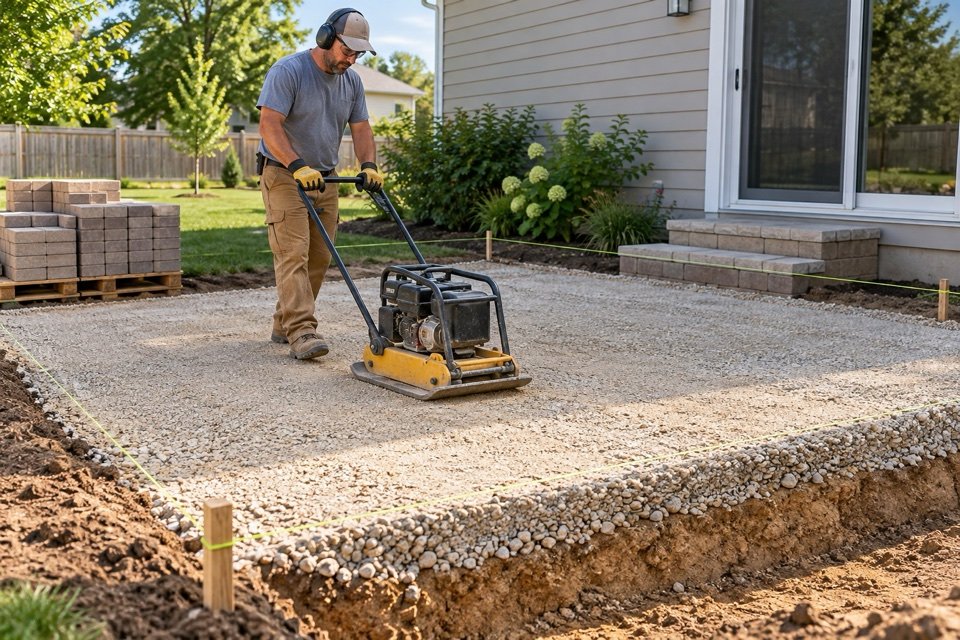
The base is the working structure beneath a flexible paver surface. Angular, properly graded aggregate can compact into a stable layer that spreads loads while allowing the assembly to manage water as designed. Depth and material selection depend on soil, climate, use and system specifications.
Iowa State University Extension describes paver-bed preparation as the most important installation step and connects pavement performance to the quality of the soil and base. Oregon State University Extension likewise recommends placing base material in smaller layers and compacting between them rather than trying to compact one deep loose layer at the end.
Uniformity is as important as total depth. A base that is thick in one area and thin in another can create different rates of movement. Filling a low place with extra bedding sand is not an equivalent substitute. The base should establish the final plane and slope before the thin bedding course is added.
Cause 3: water is entering or stopping in the wrong place
Water can weaken supporting soil, carry fine material out of joints or edges, and create conditions for seasonal movement. The source may be rainfall on the patio, but it may also be a downspout, roof valley, sprinkler, raised planting bed or uphill part of the yard.
A durable surface needs a deliberate route for water. The grade should move runoff away from the building toward an appropriate destination without creating erosion, sending water onto neighboring property or trapping it at a step. Door thresholds, siding clearance, foundation conditions and adjacent lawn elevations all constrain that route.
Do not assume that installing a drain is always the answer. Sometimes the source should be redirected before it reaches the patio. Sometimes the surface grade needs correction. A drainage feature needs capacity, cleanouts where appropriate and a lawful outlet. Our guide to standing water in Central Kansas yards explains how to trace the complete path.
Cause 4: the bedding layer was asked to correct the base
Bedding material creates a consistent setting surface and helps the pavers seat during final compaction. It is not designed to fill deep depressions or reshape an uneven base. A thick pocket can compress or move differently from the surrounding bed, leaving a dip that mirrors the original shortcut.
The correct sequence is important: prepare the subgrade, install and compact the specified base in controlled layers, establish grade, then screed a consistent bedding course. When pavers are lifted for repair, the depth and condition of each layer should be checked rather than automatically adding loose material directly below the low units.
Cause 5: the edges or joints stopped holding the field together
Interlocking units need containment. When an outer edge loses support, pavers can creep outward, joints open and bedding material becomes more exposed to movement. A lawn edge that looks tidy from above may not provide structural restraint below. Water flowing off the surface can also erode an unprotected edge.
Joint material is another working component. Empty or vegetation-filled joints allow more movement and water intrusion. Replenishing the correct joint material may be part of maintenance, but it cannot pull a failed base back into shape. Widened joints should prompt a check of the edge, base and load before they are simply refilled.
Cause 6: the use changed after construction
A patio designed for people and furniture may later become a route for heavy equipment. A walkway may receive repeated deliveries, a rolling dumpster or a vehicle tire at one corner. Concentrated loads at an unsupported edge can cause movement even when the main field remains sound.
Landscape changes also matter. Tree roots expand, beds are raised, downspouts are moved and irrigation lines are repaired. If a trench crosses the paver area, restoring the surface requires rebuilding support below the units—not only replacing the visible pieces.
Where freeze-thaw fits into the diagnosis
Central Kansas experiences freezing weather, but “frost” should not become the automatic explanation for every uneven surface. Frost-related heaving requires both freezing conditions and moisture in susceptible material. Drainage, soil, base construction and seasonal weather work together.
A surface that rises during winter and partly drops in spring provides a different clue from a depression that steadily becomes deeper. Repair planning should document that behavior. Keeping unnecessary water out of the foundation and base system is part of reducing risk, but no installation can make weather irrelevant.
Reset a few pavers—or rebuild the area?
A localized reset can be appropriate when the surrounding field is stable, the cause is limited, drainage still works and the base can be repaired without chasing failure across the project. The work may involve lifting units, removing unstable material, rebuilding and compacting the base, restoring a uniform bedding layer, resetting the pattern and replenishing joints.
A larger rebuild becomes more reasonable when settlement is widespread, water moves toward the house, edges are failing on several sides, elevations were wrong from the beginning, or the base is inconsistent across the surface. Repeated patching can become expensive without changing the underlying condition.
Concrete slabs require a different diagnosis. Cracks, vertical displacement and movement beside a foundation may involve structural, soil or water conditions beyond a paver reset. Do not grind or cover a displaced surface until the cause and safe final elevation have been evaluated.
What a lasting paver repair should address
- Safety first: identify trip hazards, unstable steps and areas that should be temporarily blocked from use.
- Water path: observe rain and irrigation, inspect downspouts and determine where runoff should end.
- Existing elevations: measure doors, siding, steps, drains, connected walks and the intended final slope.
- Utilities and access: locate public and private lines and plan how materials and equipment will reach the work.
- Subgrade and base: remove unsuitable material, repair soft areas and rebuild support for the actual load and site.
- Bedding, edges and joints: restore each part of the paver system instead of treating the surface as independent tiles.
- Connected landscape: finish lawn, beds and drainage edges so runoff cannot undermine the repaired area.
When patio work is part of a larger property plan, complete underground drainage, electrical, irrigation and conduit decisions first. Our article on what to fix first around a property can help order the work.
Could permeable pavers solve the water problem?
Permeable pavement is a specific system—not ordinary pavers with wider or unfilled joints. It allows water to pass through designed openings into open-graded layers below. The U.S. EPA notes that permeable pavement can reduce runoff, but design, construction and ongoing maintenance are essential.
The underlying soil, water table, incoming sediment, winter maintenance and overflow route all affect whether the system fits a site. Fine debris can clog openings, so vacuuming and joint maintenance may be required. A conventional sloped paver patio may be the better solution in one location; a properly engineered permeable assembly may be useful in another.
Call before excavation—and remember private lines
Kansas 811 says homeowners and contractors should request utility marking before digging, including for outdoor improvement work. The request must be made two full working days in advance, excluding the day of the request, weekends and observed holidays. Work should not begin until required responses are complete and the markings are checked.
Public utility marks may not cover privately owned sprinkler lines, landscape lighting, pool equipment, invisible fencing, septic components or power serving an outbuilding. Those facilities may require a private locator. Marks are approximate; safe excavation practices still apply around them.
What to include when requesting an estimate
Good information helps separate a surface repair from a drainage or reconstruction problem. Send wide photos showing the house and complete hardscape, close photos of settlement and joints, and images taken after rain. Include approximate dimensions, the age of the installation if known, and any record of utility, drainage or irrigation work nearby.
Describe how the area is used and whether the movement is seasonal or getting worse. Mention water entering a building, loose steps or a significant trip hazard immediately. CPS can then start the conversation with the full property context instead of estimating from one close-up of a low paver.
Have an uneven patio, walkway or step?
Send CPS photos of the complete area, the low or raised section, nearby downspouts and what happens after rain. We can review whether the project appears localized or needs broader drainage and base work.
Frequently asked questions
Why are only a few patio pavers sinking?
The low spot may follow a soft pocket, previous trench, water source, eroded edge or inconsistent base. A small visible area does not always mean the repair is only surface-deep. Check the pattern and drainage before resetting the units.
Can I fix the problem by adding sand?
A thin, uniform bedding layer helps seat pavers, but deep sand is not a replacement for a stable compacted base. If the material below is loose, wet or missing, the repair should rebuild that support first.
Does freezing weather make patios uneven?
It can contribute when water is present in susceptible soil or an inadequately drained assembly. Soil, moisture, construction and weather should be considered together rather than blaming every low or raised area on frost.
Should the patio slope away from my house?
Water should be directed away from the building toward a suitable drainage route. The exact elevation must also work with doors, siding, foundations, steps, neighboring grades and local requirements.
Do I need Kansas 811 for a repair?
Contact Kansas 811 before excavation. Also identify private lines that participating public utilities may not mark, including irrigation and landscape lighting. Do not assume the original patio area is free of buried facilities.